Teen Patti Probability Explained: Improve Your Winning Chances Smartly
April 11, 2026
The Math Behind Teen Patti: Understanding Odds & Edge
Teen Patti (Three Cards), also known as Indian Poker, Flush, Flash or 3 card Brag, is a very popular card game in South Asia. It’s quick, it’s thrilling, and it’s strategic. But behind the excitement is a layer of math that in the long run makes your chances of winning (or losing) little more than a war of inches. Whether you’re a casual gamer who just wants to have fun with your family or a serious player who wants to decrease his losses, having knowledge of the math of Teen Patti game online can provide you an edge.
In this post, we’re going to portion off the pot-odds, risks and house edge of Teen Patti, and walk you through how you can integrate these to think a little more wisely.
The importance of Maths in Teen Patti
Some players play on instinct, superstition, or by bluff. Though those all definitely contribute to the fun, the true heart of Teen Patti is probability. Each hand you play is part of a mathematical system, and what you know about how frequently certain combinations of cards show up becomes your guide for when to bet, when to fold, and when to go all in for the max reward.
Fundamentals—Teen Patti Rankings of Hands
Before we get to odds, let’s review the hand rankings in Teen Patti (strongest to weakest):
-
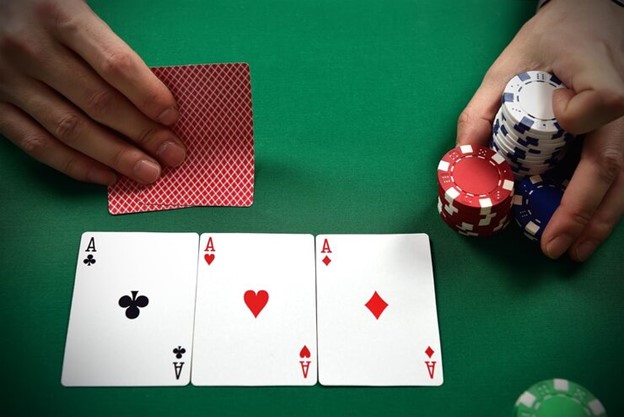
Trail (Three of a Kind) – e.g., A♠ A♥ A♦
-
Pure Sequence (Straight Flush) – e.g., 10♣ J♣ Q♣
-
Sequence (Straight) – e.g., 5♦ 6♠ 7♥
-
Color (Flush) – e.g., 2♠ 6♠ 10♠
-
Pair (Two of a Kind) – e.g., 8♣ 8♦ J♥
-
High Card – e.g., K♦ 9♣ 3♥
Using a standard 52-card deck and the fact that each player gets only three cards, the hand probabilities are unlike poker.
Chances of Receiving Every Hand in Teen Patti
Here are the approximate chances of being dealt each hand:
-
Trail (Three of a Kind): 52 possible trails → Probability ≈ 0.24% (about 1 in 424 hands)
-
Pure Sequence (Straight Flush): 48 possible → Probability ≈ 0.22% (about 1 in 450 hands)
-
Sequence (Straight): 720 possible → Probability ≈ 3.26%
-
Color (Flush): 1,096 possible → Probability ≈ 4.96%
-
Pair: 3,744 possible → Probability ≈ 16.94%
-
High Card: Remaining hands → Probability ≈ 74.39%
👉 This means most of the time (3 out of 4 hands), you’ll only have a high card. That’s why bluffing is such a big part of Teen Patti.
Probability at Work in Decision Making
Here are some possibilities:
- When You Have a Pair: Pairs come up about 1 in 6 hands, so they’re better than your average opponent’s hand. As long as bets don’t run too large, playing aggressively often makes sense.
- When You Get a Flush (Colour): Only a 5% chance, but this is scarce and offers tremendous power. But it gets owned by sequences or higher, so calculate the risks before you over-commit.
- When You Have a High Card: Only the majority of hands (74% of them) fall into this category. Folding will likely keep you from spending even more money. But if you can bluff well, you can turn a losing hand into a winner.
Understanding the Edge
In Teen Patti, the “edge” is about who has the mathematically superior long-term position. Because unlike games you’d find in a casino—roulette or blackjack—Teen Patti is a player-versus-player game, so the house (if you’re playing online or at a club) generally takes a rake—a small percentage of the pot.
- Player Edge: All comes from understanding probability, reading opponents and betting intelligently.
- House Edge: A cut from rake or entry fees. Even if you’re the best player, the house will win over time.
This is: When you don’t play strategically, you lose not only to superior players, but to the rake.
Smart Strategies Based on Math
Here are some math-endorsed tips:
- Play Tight Early: Most hands are weak early on, so fold more often and you won’t drain your stack.
- Bet Strong with Uncommon Hands: If you have trails, pure sequences, or even a pair, you’re already ahead of the average hand. Don’t be shy about playing for larger pots.
- Bluff Sparingly: Since high cards are in control here, many players will fold when they detect strength. But do not over-bluff — statistics will catch up with you.
- Understanding pot odds: Compare the amount you have to call with the size of the pot. When the risk is small relative to potential winnings, calling is the right thing to do.
- Bankroll Management: You may still have the best chances, but variance (luck) plays a huge role in the short term. Setting a ceiling keeps you from winning streaks and bad runs.
Real-Life Example
You’ve got a pair of 9s, and the likelihood of your opponent holding a higher pair is slim (only 5 possible pairs that beat you), but they could have a straight or flush. You hold a hand that statistically beats 74% of all high-card poker hands and that ties or beats the majority of pairs.
👉 Right move: Stay in the game and bet conservatively. Folding would squander your mathematical edge.
How This Information Helps You Win
In Teen Patti, most players play with emotions—being pot-committed, overestimating a weak hand, or bluffing too often. If you play based on mathematical reality, you are:
- Reduce unnecessary losses
- Identify profitable spots
- Understand when bluffing is worthwhile
- Protect your bankroll against variance
The law of large numbers takes over after many sessions, and probability cancels itself out. Those players who get the math right are always more successful than those who don’t.
FAQ’s
Q1: Is Teen Patti purely luck-based?
No. Your cards are determined purely by chance, but probability, strategy, and psychology determine the long-term victor.
Q2: What is the most uncommon hand in Teen Patti?
A Trail (Three of a Kind) is the least common, occurring just 0.24% of the time.
Q3: How do I know when to bluff?
Bluff when you’ve got a good table image and your opponents are weary. Don’t try to bluff calling stations.
Q4: What is the Teen Patti house edge?
The game itself has no natural house edge, but online rooms collect rake (2–5%) from each pot, which enables the house to win over the long run.
Q5: Does math have the power to assure victory in Teen Patti?
There are no short-term guaranteed winning strategies. Math helps to reduce your losses and improve your chances of winning over the long term.
Q6: Should I always play pairs?
Yes, in general, since pairs are among the strongest possible hands. Mind your moneyBut beware if betting explodes—you may be up against a sequence or trail.
Final Thoughts
Teen Patti isn’t just luck or social bluffing—it’s a game of numbers. It is by knowing the odds of a situation, realising just how uncommon each hand happens to be, and utilizing common sense to make the right call that you can stack the odds in your favour. The more math you use in your Teen Patti strategy, the more consistently you can rely on that outcome.
So next time you settle down at a Teen Patti table, bear in mind that behind every hand is a mathematical tale. Learn it, master it, and bluff smarter.